
If you have tried to build or upgrade a PC in the last six months, you know the feeling of pure, unadulterated sticker shock. We are currently living through “RAMageddon,” a global memory shortage that has sent component prices into the stratosphere. When a simple stick of RAM starts eating up a third of your entire build budget, the dream of a high-end setup begins to feel like a fantasy.
But just as the industry seemed ready to abandon the “budget” gamer entirely, Alienware dropped a bomb. The Alienware 27 (AW2726DM) QD-OLED has arrived with a $350 price tag. In an era where even mid-range monitors are creeping toward the thousand-dollar mark, this isn’t just a new product; it’s a sophisticated rebellion against the rising cost of play.
The QD-OLED Deficit: High Stakes, Low Price
For the uninitiated, QD-OLED (Quantum Dot Organic Light Emitting Diode) is the “gold standard” of display tech. It offers the inky, perfect blacks of an OLED with the vibrant, saturated colors of Quantum Dots. Usually, seeing those five letters on a box means you’re about to drop a month’s rent.
Alienware’s strategy here is a masterclass in utility-first design. To hit that $350 sweet spot, they stripped away the “gamer fluff” that inflates the price of their premium models. There is no RGB lighting. There are no fancy built-in speakers. There isn’t even a USB hub for data transfer. What you get instead is a raw, 27-inch QHD (1440p) panel that runs at a blistering 240Hz refresh rate. It’s a “no-frills” approach that prioritizes the actual experience of looking at the screen over the vanity of the desk setup.
The Visual Reality: A Window Into Better Worlds
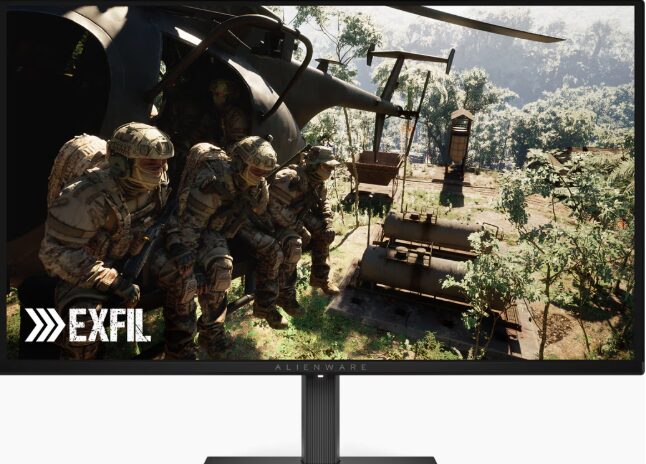
When you fire up a game on the AW2726DM, the difference between this and a standard LCD is immediate and jarring. Because every pixel is its own light source, the contrast is infinite. Shadows aren’t just “dark grey”; they are pitch black.
The panel covers 99 percent of the DCI-P3 color gamut, providing a level of richness that makes even older games feel remastered. However, the budget price does come with a sunlight tax. The monitor averages about 200 nits of typical brightness, which is significantly dimmer than its $900 rivals. If your gaming lair is flooded with natural sunlight, the glossy finish will act like a mirror. But for the “night owl” gamer who plays in a darkened room, the visuals are nothing short of spectacular.
The Burn-In Boogeyman: Solved?
The biggest psychological barrier to buying an OLED has always been burn-in, that permanent “ghost” image left behind by static HUDs or taskbars. Alienware is tackling this head-on with a three-year warranty that explicitly covers burn-in.
They’ve also integrated a graphite film heatsink and an AI-driven “pixel care” algorithm to keep the panel healthy. It’s a bold move that shows they aren’t just selling a cheap screen; they are selling peace of mind. In a world where Samsung is increasing Galaxy prices due to the same cost pressures, seeing a company offer more protection for less money is a refreshing change of pace.
The Ergonomic Compromise
While the screen is a masterpiece of value, the stand is where you feel the “budget” constraints. It’s a simple, square 8.75-inch base. While it supports height, tilt, and even pivot adjustments (allowing you to flip the monitor into portrait mode), it takes up a fair amount of desk real estate.
If you are the type of competitive player who likes to jam your keyboard right up against your monitor, you might find the stand a bit intrusive. However, since the panel is VESA-compatible; you can easily swap it for a desk arm later when your “RAMageddon” savings account recovers.
The Verdict: A New Benchmark for 2026
The Alienware AW2726DM is the most important monitor released this year because it refuses to participate in the “luxury-only” trend of 2026. It proves that you don’t need to spend $2,500 on a foldable phone or $900 on a professional display to have a world-class digital experience.
Yes, it’s a bit dim in a bright room. Yes, the text fringing means it’s not a perfect choice for 10-hour spreadsheet sessions. But as a window into your favorite gaming worlds, it offers a level of performance that was unthinkable at this price point just a year ago. It’s a beacon of hope for the budget-conscious, proving that even in a crisis, innovation doesn’t always have to come with a massive “innovation tax.”
