
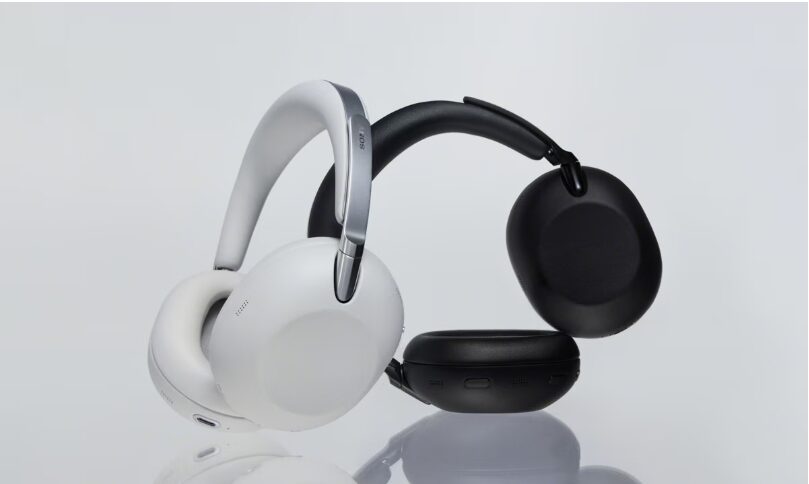
To celebrate a decade of dominating the active noise-canceling (ANC) market, Sony is shifting its design philosophy. Rather than rolling out another iteration of its plastic-bodied commuters, the tech giant has released the 1000X The Collexion (priced at a premium $650).
This anniversary flagship represents a pivot toward luxury craftsmanship and high-fidelity sonics, sitting intentionally above the everyday workhorse WH-1000XM6. However, much like XGIMI’s Titan Noir Max 2000 Max, which delivers premium cinema quality while inexplicably omitting a crucial feature, Sony’s upscale experiment pairs gorgeous material improvements with some highly frustrating, practical omissions.
A Complete Structural Overhaul
The most immediate change is the total elimination of the matte plastic chassis that defined previous generations.
- The Premium Materials: Sony has swapped out the plastic components entirely, wrapping the physical frame in a tactile combination of premium faux leather and sandblasted aluminum linkages.
- The Comfort Tuning: To offset the added weight of the metal components, which bumps the scale up to roughly 312–320 grams compared to the featherweight 254-gram XM6, Sony completely re-engineered the headband. The cushion padding is 40% thicker, the band itself is visibly wider to distribute pressure evenly, and the internal earcup volume has been expanded to prevent ear-crowding. The result is a dramatically reduced clamping force that gracefully melts away during long listening sessions.
- The Portability Compromise: This luxury build requires structural sacrifices. The redesigned headband and stepless metal sliders mean the earcups only rotate flat to fit into their custom, handbag-style magnetic case. They completely lose the ability to fold inward toward the headband, as the standard WH-1000XM6 does, making them significantly more cumbersome to quickly shove into a crowded backpack.
Acoustic Upgrades Meet Algorithmic Upscaling
On an audio level, The Collexion moves away from the bloated, bass-heavy presentation typical of the consumer market, aiming instead for an open, studio-oriented signature sound.
Sony achieved this by deploying newly developed unidirectional carbon composite drivers. These drivers are angled within the deep earcups to project sound waves naturally toward the user’s pinna, substantially widening the perceived soundstage and bringing out delicate high-frequency details. The underlying audio circuitry has been optimized to scrub out noise-floor hiss, resulting in a cleaner signal-to-noise ratio.
For compressed digital tracks, the headphones mark the debut of DSEE Ultimate on a 1000X-series headset. This next-gen audio upscaling technology leverages AI sound enhancement to actively reconstruct complex musical textures and microscopic details that are typically stripped away during Bluetooth compression.
Physical Spatial Controls vs. Battery Degradation
Sony has also ironed out some long-standing software frustrations by introducing physical tactile controls on the left earcup.
On the older WH-1000XM6, switching to specialized spatial audio modes required diving deep into the menus of Sony’s Sound Connect mobile app. The Collection fixes this by placing a dedicated physical hardware button above the standard noise control toggle. Pressing it cycles instantly between two brand-new hardware-level spatial audio upmixing environments: Music and Game, bypassing the app entirely.
Despite these luxury finishes, the headphones suffer a glaring regression where it hurts most: power.
- Shrunk Playtime: The slimmer profile of the physical earcups leaves less internal room for battery cells. Consequently, battery life takes a noticeable hit, dropping from the XM6’s standard 30 hours down to 24 hours of playback with ANC enabled.
- Sluggish Fast-Charging: The fast-charging architecture has also slowed down. While the standard XM6 can net 3 hours of juice from a lightning-fast 3-minute charge, the Collexion requires a longer 5-minute charge to deliver a lesser 1.5 hours of playback.
- The Empty Box: To make matters worse for a $650 product, Sony has omitted a USB-C charging cable from the retail packaging, forcing users to supply their own cords to power the headset.
