

Corporate labor negotiations are reaching a breaking point as workforce expectations collide with soaring executive profits. This sudden pushback from employees demanding their fair share of institutional wealth mirrors similar disruptions in the consumer technology market, where devices like Nothing’s Phone 4a and Phone 4a Pro are heavily challenging the old status quo by packing premium aluminum design principles and high-end hardware into aggressively priced, community-first alternatives. Now, instead of a disruptive hardware startup challenging a premium smartphone monopoly, tens of thousands of tech manufacturing personnel are forcing a structural reckoning at the highest level of corporate management. Nearly 48,000 Samsung workers in South Korea are officially planning to walk out for a massive 18-day strike.
Representing an astonishing 38 percent of Samsung’s entire domestic labor force, this coordinated labor revolt follows a bitter breakdown in high-stakes contract negotiations. While union leader Choi Seung-ho confirmed that his organization was fully willing to accept a compromised structural framework proposed by an official government mediator, the peace talks collapsed entirely over a single, uncompromising point of friction: worker bonuses.
The Profit Stash: Breaking Down the Union’s Financial Demands
At the center of this industrial standoff is a direct dispute over the wealth generated by the global artificial intelligence and cloud computing boom. The labor union is pushing a multi-tiered financial mandate designed to permanently lift long-standing caps on employee compensation:
- Lifting the Earnings Ceiling: Workers are demanding that Samsung completely remove the current restrictive cap on individual employee bonuses, which is tightly locked at 50 percent of their annual base salaries.
- Direct Revenue Sharing: The union is aggressively lobbying the tech giant to allocate a mandatory 15 percent of its entire annual operating profit directly into worker bonus pools.
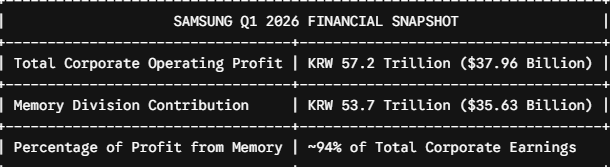
The timing of the strike could not be more dangerous for Samsung’s executive board. As the undisputed global leader in DRAM and high-bandwidth memory manufacturing, the corporation has been reporting record-breaking financial quarters, driven directly by its hardware division. During the first quarter of 2026 alone, the specific semiconductor division housing its memory operations generated a jaw-dropping KRW 53.7 trillion ($35.63 billion) in pure operating profit. That single sector accounted for almost all of Samsung’s aggregate KRW 57.2 trillion ($37.96 billion) in corporate profit for the quarter.
The Standoff: Excessive Demands vs. Corporate Principles
Because the overwhelming majority of the striking workforce is deeply embedded within the silicon fabrication plants of the company’s memory division, a prolonged 18-day walkout threatens to choke production of the company’s undisputed financial engine. If management blinks and capitulates to the labor union’s strict terms, everyday line workers stand to receive life-changing payouts stretching into millions of total dollars. However, Samsung executives have flatly labeled the union’s economic blueprint as completely “unacceptable.”
In an official public statement, Samsung management argued that moving past their current financial limits would create a dangerous precedent, noting that “accepting the labor union’s excessive demands would undermine the fundamental principles of company management.” The union, conversely, pointed to local industry benchmarks to justify their aggression, highlighting that workers at bitter domestic rival SK Hynix walked away with bonus packages roughly three times larger than Samsung employees received during the previous calendar year.
The Legal Vise: Forcing the Plants to Stay Alive
Anticipating severe logistical paralysis across its multibillion-dollar manufacturing lines, Samsung successfully lobbied the South Korean court system to secure an emergency injunction. The judicial ruling imposes a strict constraint on the union’s strike leverage, legally requiring a minimum of 7,087 essential personnel to report to their assembly stations every day to ensure that vital microchip fabrication plants do not completely freeze.
Despite the impending legal buffer, the volatile situation remains in flux. Samsung representatives have publicly stated that the firm “will not give up on dialogue until the last moment,” maintaining a rigid public posture that “there must be no strikes under any circumstances.” Meanwhile, South Korean Labor Commissioner Park Soo-keun confirmed that state-level authorities are on standby to step back in and mediate the second round once both factions agree to return to the peace table.
The Final Verdict
Samsung’s escalating labor war is a textbook example of the friction underlying the modern technology boom. When an industry generates eye-watering wealth on the backs of its manufacturing base, corporate entities can no longer expect workers to quietly accept rigid legacy pay caps. Whether through a state-mediated resolution or a prolonged, highly disruptive 18-day factory freeze, the outcome of this South Korean standoff will set a new benchmark for how profits in global tech infrastructure are distributed.
