
The home theater ecosystem is undergoing a massive shift as premium visual tech becomes more accessible, arriving right as consumer demand for high-end home cinema setups has skyrocketed, leading many enthusiasts to actively hunt for the best portable projectors for 2026 to establish a theater experience without dealing with bulky television panels. Amidst this rush for cinematic independence, XGIMI has rolled out its latest heavy hitter: the XGIMI Titan Noir Max. On paper, this device positions itself as a luxury powerhouse, boasting an elite design, premium brand partnerships, and flexible setup mechanics. Yet, behind its flashy exterior and the glowing gold logos, XGIMI has made an incredibly controversial and frustrating design choice. They have completely stripped out the built-in smart operating system, asking you to spend premium money on a device that cannot even stream a basic movie out of the box without extra hardware.
The Luxury Chassis vs. The Alien Aesthetic
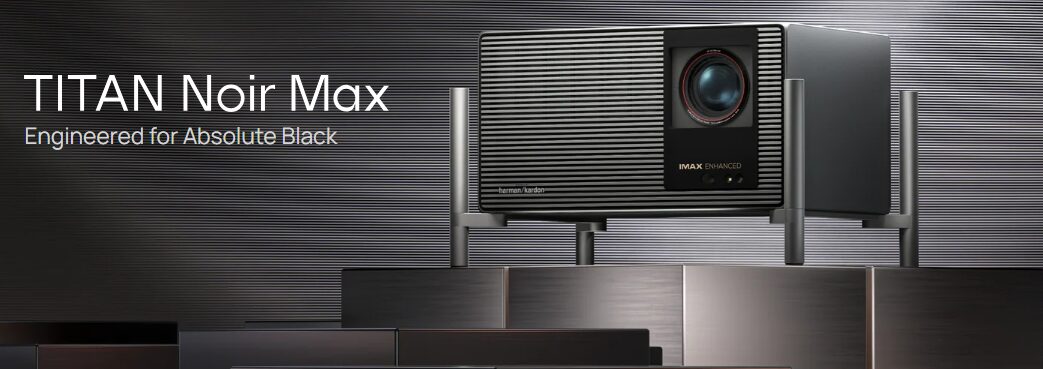
XGIMI clearly spent a significant portion of its development budget trying to make the XGIMI Titan Noir Max look like a piece of high-end audio-visual furniture. The projector sports a subtle, classy design featuring a grey metal chassis, a front-facing grill, and an understated red ring around the lens area. To further cement its premium status, the body proudly displays branding from audio giants Harman Kardon alongside a shiny, gold “IMAX Enhanced” logo. It even ships with an elegant custom carrying box and a beautiful, silver-accented remote control to complete the luxury unboxing experience.
However, once you look past the premium branding, the physical footprint becomes a bit more polarizing. The projector is roughly the same overall size as its direct market rival, the Valerion VisionMaster Max. But instead of sitting flush on a standard base, the XGIMI Titan Noir Max rests on distinct, tube-like feet. Rather than looking sleek, these support pegs give the projector a slightly awkward, alien appearance that might stick out like a sore thumb on a modern living room coffee table.
Premium Hardware, Lazy Software
When it comes to physical placement, the internal lens hardware is undeniably impressive, offering incredible flexibility for dedicated home theater spaces. Armed with a 0.98-2.0x zoom lens, the XGIMI Titan Noir Max allows users to adjust their setup distance anywhere from 8.7 to 17.4 feet away from the wall, throwing a massive image size up to 300 inches. Even better, it supports a wide mechanical lens shift range 50 percent horizontally and 130 percent vertically. This means you can place the projector well off-center on a side table and still get a perfect image without resorting to digital keystone correction, which actively destroys image resolution.
Unfortunately, the automatic setup software fails to match the quality of the physical lens. While the XGIMI Titan Noir Max does feature a one-button automatic keystone system to snap the image into place, the software is surprisingly finicky. During real-world testing on a standard 120-inch matte screen, you have to manually fiddle with the projector and physically move it to get the image roughly close to the screen’s borders before the auto-adjustment button will work properly. Competing devices on the market, such as Anker’s Nebula X1 or the Valerion VisionMaster Max, handle this process seamlessly. On those rival models, the auto-screen alignment works effortlessly as long as the projected image is larger than the frame, sparing you the annoying manual guesswork.
Silent Processing and Plenty of Ports
Where the XGIMI Titan Noir Max genuinely succeeds is in its physical connectivity and thermal management. The rear of the unit is packed with a robust selection of ports, including three HDMI 2.1 inputs one of which is fully equipped with eARC to easily route high-quality audio to an external soundbar. It also features an S/PDIF optical port, a standard USB-A port, a 3.5mm headphone jack, and a gigabit ethernet connection for stable, high-speed wired networking.
It is worth noting that the XGIMI Titan Noir Max completely lacks the advanced liquid cooling systems found in hardware like the Nebula X1. Despite relying on more traditional cooling methods, the engineers managed to make this machine whisper-quiet. Under normal operating conditions from two feet away, the fan noise registers at a practically silent 18 decibels. Even when you crank the projector’s brightness settings to the absolute maximum, the fan noise only steps up to a highly manageable 24 decibels, ensuring that quiet movie scenes won’t be ruined by a whirring internal turbine.
The Streaming Embargo: A Dealbreaker for the Modern Home?
Everything comes crashing down, however, when you turn the projector on and realize that XGIMI has completely omitted Google TV, Android TV, or any built-in smart streaming platform. If you want to watch Netflix, Disney+, YouTube, or Prime Video, you are completely out of luck unless you go out and purchase a separate Apple TV 4K, a Google TV streaming stick, or a dedicated media box.
For tech enthusiasts who already own spare streaming dongles, this might sound like a minor inconvenience. In fact, some purists actually prefer using an external stick because built-in projector software interfaces are notorious for being sluggish, poorly optimized, and laggy. But for the average consumer spending premium money on a flagship projector, being forced to plug a messy, cheap plastic streaming stick into the back of a luxury Harman Kardon-branded machine just to watch a movie feels like an insulting omission. This lack of immediate, out-of-the-box streaming access strips away the portability of the device and will undoubtedly push many buyers straight into the arms of competitors who offer a true all-in-one smart system.
The Final Verdict
The XGIMI Titan Noir Max is a deeply frustrating paradox. It delivers spectacular, near-silent hardware performance, versatile lens shifting, and a beautiful industrial design that promises a premium theater experience. Yet, by skimping on basic software integration and delivering an auto-calibration system that feels steps behind the competition, XGIMI has made their flagship device incredibly hard to recommend for casual users. Unless you are a dedicated home theater purist who intends to pair this exclusively with a high-end external media player, you are probably better off looking at smarter, more complete options in the competitive landscape
